
Checkers: Rules, Strategy, and FAQ
Everyone thinks they know checkers, and almost everyone underestimates it. One page covers it all: the real rules with diagrams, the two kinds of kings, the strategy that wins, and the questions players actually argue about.
Last updated:
The Rules
Checkers is played on the dark squares of an 8 by 8 board. Each player starts with 12 pieces, called checkers, arranged on the dark squares of their first three rows. In our game the sides are Red and Black; Red moves first, Red marches up the board, and Black marches down. The light squares are never used by anyone, all game long.
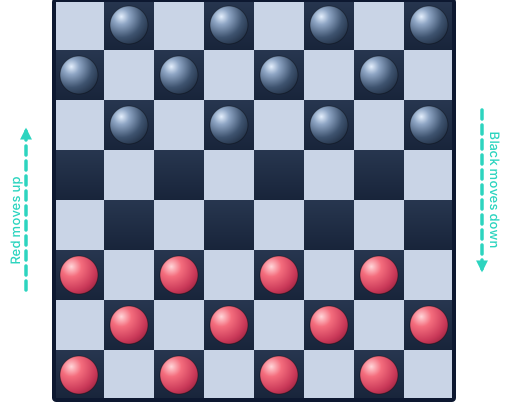
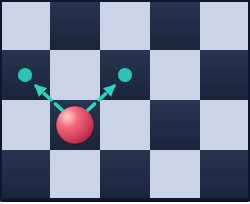
Moving A regular piece moves one square diagonally forward, toward the opponent, onto an empty dark square. That is the entire movement rule for most of the game, and the simplicity is deceptive: with every piece locked to forward diagonals, every advance is permanent. There is no retreating to fix a mistake.
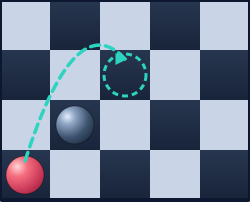
Capturing When an enemy piece sits diagonally ahead of you with an empty square directly beyond it, you capture by jumping over it and landing on that empty square. The jumped piece comes off the board. And here is the rule that defines checkers: captures are mandatory. If a capture is available anywhere on your turn, you must take one. The board enforces this for you, highlighting only the legal moves.
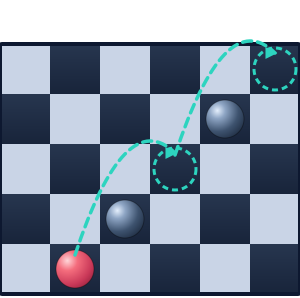
Chain captures If your piece lands and can immediately capture again, it must keep jumping in the same turn, as many times as the captures keep coming. A single piece clearing two or three enemies in one move is the signature spectacle of checkers, and entire games are won by engineering exactly that.
Kings, and the two rulesets Reach the opponent's back row and your piece is crowned a king, marked with a crown. Kings move and capture both forward and backward, and this is where our two rulesets part ways. Under American rules, a king steps one diagonal square at a time, in any direction. Under International rules, kings fly: they travel any number of open diagonal squares and capture across distance, like a bishop in chess. One honest note for purists: classic international draughts is traditionally played on a 10 by 10 board; our version brings its flying kings to the familiar 8 by 8, so you can feel the difference between the two king styles on the same board. In both rulesets, regular pieces play exactly the same: forward moves, forward captures.
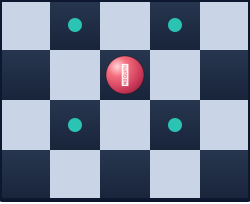
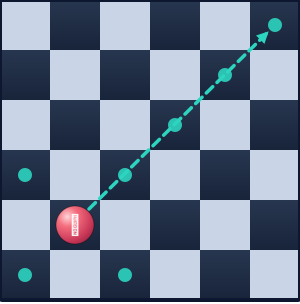
Winning, and the draw Capture all of your opponent's pieces, or leave them with no legal move on their turn. The second one is easy to forget: trapping the last enemy pieces so they cannot move at all wins the game just as completely as clearing the board. And not every game finds a winner: when each side is down to a single checker, the game is declared a draw, and the same happens after 20 consecutive moves with no capture, so two kings cannot chase each other forever.
Strategy: Six Habits That Win Checkers Games
The forced capture is a weapon Because your opponent MUST jump when offered a capture, you can make their moves for them. The most common winning trick in checkers is the two-for-one shot: deliberately offer a piece where the forced capture drags the enemy piece onto a square you have covered, then take two back. Every strong checkers player thinks in these forcing sequences, and every beginner falls for them. When an opponent hands you a free piece, pause: in checkers, gifts have prices. Look at where the forced jump puts you before celebrating.
Hold your back row Your four back-row pieces are the gatekeepers of the crowning squares. Every back-row piece that stays home is a king your opponent has not made yet. The classic advice is to keep the back row intact as long as practical and advance with your middle pieces first; once the position demands it, release the back row pieces one at a time, not all at once.
Fight for the center Center squares touch more diagonals, which means more move options and more capture threats. Pieces hugging the side of the board control half as many squares; an edge piece can never be captured, which tempts beginners, but safety that comes with passivity loses games slowly. Strong play uses the edge sparingly and the center constantly.
Trade when ahead, complicate when behind Checkers arithmetic is brutal: being one piece up out of twelve is small, but one up out of three is overwhelming. Every equal trade magnifies a material lead, so when you are ahead, force exchanges and simplify toward an endgame your extra piece dominates. Behind? Avoid trades, keep pieces on, and hunt for the double-jump tactic that swings it back.
Race wisely for the crown The first king changes everything: it attacks in all four directions while regular pieces can only face forward, so it raids the enemy rear at will. But the path matters. A piece sprinting up an open flank toward the crown can leave the squares behind it weak, and a forced capture at the wrong moment turns the runner into a casualty. Advance toward crowning on the wing where your opponent is weakest, with a second piece supporting from behind. In endgames, remember the double corner (the corner with two diagonals): under American rules a lone king can hold out there for a long time, and chasing it down is a skill worth practicing against the AI.
Mind the ruleset Under International rules, flying kings turn every open diagonal into a highway, so leaving long unguarded diagonals near the endgame is fatal, and the first crowned king is even more dominant than usual. Under American rules, king endgames are slower, more positional, and more forgiving. The same opening principles apply to both; the endgames feel like different games, which is exactly why we offer the choice.
Frequently Asked Questions
Who goes first?
Red moves first in our game, then turns alternate. When you create an online game you pick your color, and against the AI you decide which side it plays. If you play a series against a friend, swap colors between games; the first move carries a small edge.
Do I really have to capture?
Yes, always. If a capture is available on your turn, you must take one, and if your piece can keep jumping from where it lands, the chain must continue in the same turn. This is not a house rule we chose; mandatory capture is the official rule in every serious form of checkers, and it is what gives the game its tactical teeth. The board enforces it automatically: when a capture exists, only capturing moves light up. If your piece seems stuck, look again; somewhere on the board a jump is waiting.
If I have several possible captures, can I choose?
Yes. When more than one capture is available, the choice between them is entirely yours, in both rulesets. You may take a single jump even when a longer chain exists elsewhere. One note for tournament players: official international draughts adds a majority rule that forces the sequence capturing the most pieces; our version does not enforce it, which keeps the choice (and the responsibility) with you.
Can a regular piece capture backward?
Not in our game. Regular pieces move and capture diagonally forward only, in both the American and International rulesets. All four directions belong to kings alone, which is precisely what makes the crown worth racing for. (Players who learned other traditions may know variants where men capture backward; if you are used to one, this is the rule to recalibrate.)
What is the difference between American and International rules here?
The kings. American kings step one diagonal square at a time in any direction. International kings fly: any number of open diagonal squares per move, with captures across distance. Everything else (board, setup, regular piece rules, mandatory captures) is identical between the two. Classic international draughts is traditionally a 10 by 10 game; our version brings its signature flying kings to the standard 8 by 8 board so you can switch between king styles without learning a new board. Try a few games of each; the endgames feel remarkably different.
How do I get a king, and what changes?
March a piece to the opponent's back row and it is crowned on the spot, marked with a crown symbol. From then on it moves and captures backward as well as forward, and under International rules it also flies along open diagonals. The first king in a game is usually a decisive advantage: it raids behind enemy lines where regular pieces can never defend, because they cannot turn around.
How does a game end? Can it be a draw?
Two ways to win: capture every enemy piece, or leave your opponent with no legal move on their turn. The blockade win is real and catches new players off guard; a few pieces pinned against the edge with nowhere to step lose the game even though they are still on the board. If you are down to your last pieces, keep an escape square in mind, not just an escape plan.
And yes, draws happen. The game is declared a draw in two situations: when both players are down to a single checker each, and when 20 consecutive moves pass without any capture. The second rule is what stops two lone kings from circling each other forever; if neither side can force progress, the game calls it honestly.
How do I start a game against the AI?
Everything happens in the quick setup panel on the checkers page. The numbers below match the numbers on the screenshot:
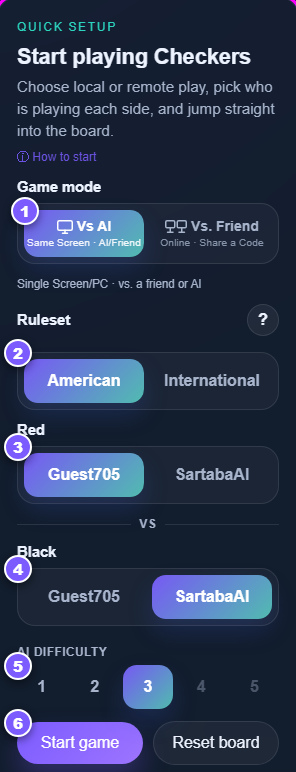
- Make sure the game mode is set to Vs AI (same screen). It is the default, so usually there is nothing to do here.
- Pick a ruleset: American (stepping kings) or International (flying kings).
- Choose who plays Red: yourself or SartabaAI. Remember Red moves first.
- Choose who plays Black the same way. One side belongs to the AI; if you hand it the other side instead, the first side automatically becomes yours.
- Pick the AI difficulty, from 1 (relaxed) to 5 (merciless).
- Press Start game and make your first move.
Two details worth knowing: you can change ruleset and difficulty between games, and if you set both sides to human players, the same screen becomes a board for two, with a friend beside you taking the other color.
How can I invite a friend to play?
Playing against a friend takes one player creating the game and one player joining it. The numbers below match the numbers on the screenshot:
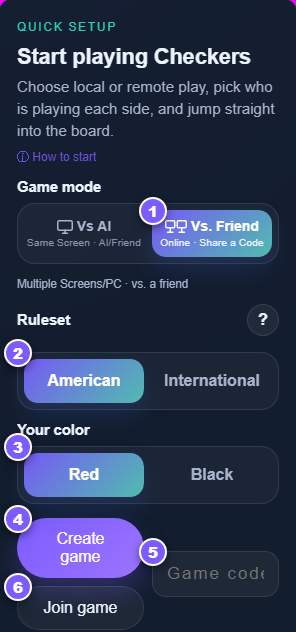
- Switch the game mode to Vs. Friend (online, share a code). Both players do this.
- As the creator, pick the ruleset for the match.
- Pick your color. Your friend automatically gets the other one.
- Press Create game. A 6-digit game code appears. Send it to your friend however you like.
- Your friend types that code into the game code box.
- Your friend presses Join game, and the match starts the moment the connection is made.
The creator sets all the game options, including the ruleset, so the joining player does not need to touch the setup at all. The same flow works in every game on the site, not just checkers.
What difficulty should I start at?
Level 1 or 2 if you are new: they walk into two-for-one shots the way human beginners do, giving you live practice at the forcing tactics from the strategy section. Level 3 plays a solid casual game and rarely hangs pieces. Levels 4 and 5 calculate deep forcing sequences and will happily feed you a piece in order to win two back three moves later; when that happens, replay the sequence and study the trap. Move up whenever you win more than half your games.
Can I play for free?
Yes. The game runs in your browser with nothing to install and no account needed for casual play. Three ways to play: a friend on the same screen, a friend anywhere in the world via game code, or SartabaAI at five levels, in either ruleset. A free account is optional and adds saved statistics and a place on the leaderboard.
Still have a question?
Send it through our contact page. Real questions from players are where half of this FAQ came from, and we read everything.