
Chess Rules: The Complete Guide
Every rule of chess in one page, from setting up the board to the three special moves that surprise even experienced players. The diagrams below use the same pieces you will see on our board, so what you learn here looks exactly like what you will play.
Last updated:
The Board and Starting Setup
Chess is played on an 8 by 8 board of 64 alternating light and dark squares. Each player commands 16 pieces: eight pawns, two rooks, two knights, two bishops, one queen, and one king. White always moves first, then the players alternate, one move per turn. Skipping a turn is not allowed.
Two setup details trip people up. First, the board must be oriented so each player has a light square in their bottom right corner. Second, the queen starts on her own color: the white queen on a light square, the black queen on a dark square. If the kings and queens face each other across the board, you have set it up correctly. On our site the board is always set up for you, but it is worth knowing for the real thing.










How the Pieces Move
Six piece types, six movement patterns. A piece captures by moving onto a square occupied by an enemy piece, which is then removed from the board. You can never capture or land on your own pieces, and only the knight may jump over anything.
Pawn
Moves one square straight forward, or two squares on its very first move. Here is the twist that surprises every beginner: the pawn captures differently from how it moves. It can only capture one square diagonally forward, and it can never capture straight ahead. A pawn blocked by an enemy piece directly in front of it is simply stuck.
Rook
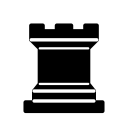
Moves any number of squares horizontally or vertically. Rooks are powerful on open files and ranks, and they grow stronger as the board empties out. Each player starts with two, tucked into the corners.
Knight
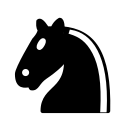
Moves in an L shape: two squares in one direction, then one square at a right angle. The knight is the only piece that jumps over others, friend or enemy, which makes it dangerous in crowded positions where nothing else can move freely.
Bishop
Moves any number of squares diagonally. Each bishop is locked to the color of square it starts on for the whole game, which is why players talk about a light-squared bishop and a dark-squared bishop. Together they cover the whole board; alone, only half of it.
Queen
Moves any number of squares in any straight line: horizontal, vertical, or diagonal. She combines the rook and bishop in a single piece, making her by far the strongest piece on the board. Losing her without compensation usually loses the game.
King
Moves one square in any direction. The king is not a fighting piece for most of the game, but he is the whole game: if your king is trapped with no escape, you lose. The king may never move onto a square attacked by an enemy piece. One important consequence: if it is your turn, your king is NOT in check, but you have no legal move anywhere, that is a stalemate and the game is an immediate draw. See check, checkmate, and stalemate below.
Castling
Castling is the only move where two of your pieces move at once, and the only time the king travels two squares. The king slides two squares toward a rook, and that rook hops over to land directly beside him. You can castle short (toward the closer rook) or long (toward the farther one).
The conditions matter, and they are strict. Neither the king nor that rook may have moved earlier in the game, not even once. This is the condition beginners miss most often: even if the piece later returns to its starting square, the right to castle with it is gone forever. Beyond that, the squares between them must be empty, and the king cannot castle while in check, cannot pass through a square attacked by an enemy piece, and cannot land on one. One common mix-up: it is fine if the rook is attacked or passes through an attacked square. The attack restrictions apply to the king only.
En Passant
The most misunderstood rule in chess, and honestly one of the most elegant. When a pawn uses its two-square first move to land directly beside an enemy pawn, that enemy pawn may capture it as if it had only moved one square. The capturing pawn moves diagonally to the square the double-stepper skipped over, and the double-stepper is removed.
The catch: this capture is only available on the very next move. Wait one turn and the right is gone forever. The rule exists for a good reason. When the two-square pawn move was added centuries ago to speed up the game, players realized it let pawns sneak past enemy pawns without ever being capturable. En passant closed that loophole.
Pawn Promotion
When a pawn reaches the far end of the board, it must immediately become another piece: a queen, rook, bishop, or knight of its own color. It cannot stay a pawn and it cannot become a king. Nearly everyone chooses a queen, but promoting to a knight occasionally wins games a queen cannot, usually by delivering an immediate fork or checkmate.
Promotion is not limited by the pieces already on the board. You can have two queens, or in theory nine. On our board, a popup appears when your pawn reaches the last rank so you can pick your new piece.
Check, Checkmate, and Stalemate
When a king is attacked, it is in check, and the rules demand you deal with it immediately. You have exactly three options:
- Move the king to a safe square that no enemy piece attacks.
- Capture the attacking piece, with the king or with any other piece.
- Block the attack by placing one of your pieces in its path. This works against bishops, rooks, and queens, but never against a knight, whose attack jumps over anything in the way.
Any move that leaves your own king in check is illegal, including moves by other pieces that would expose him.
Checkmate is check with no way out. No escape square, no capture, no block. The game ends on the spot, and the player delivering mate wins. The king is never actually captured in chess; trapping him is enough.
Stalemate is the situation people confuse with checkmate, and the difference is everything. If a player has no legal move at all but their king is NOT in check, the game is an immediate draw. Many a winning player has carelessly stalemated a cornered enemy king and thrown away the full point. When you are far ahead, always give the enemy king somewhere to move.
How Games End in a Draw
Beyond stalemate, chess has several other paths to a draw, and our game enforces all the standard ones:
- Threefold repetition: the same position, with the same player to move and the same legal options, occurs three times. Perpetual check is the classic example.
- The 50-move rule: fifty consecutive moves by each side pass without any pawn move or any capture. This prevents endless shuffling in dead positions.
- Insufficient material: neither side has enough pieces left to ever deliver checkmate, such as king against king, or king and bishop against king.
- Agreement: in over-the-board chess, players can simply agree to a draw at any point.
Try the Rules on a Real Board
Rules stick when you use them. Open our chess board, set the AI to level 1 or 2, and play a few casual games. The board highlights every legal move when you pick up a piece, so the movement rules reinforce themselves while you play. Castling, en passant, and promotion all work exactly as described above.