Connect 4: Rules, Strategy, and FAQ
Thirty seconds to learn, years to master, and far deeper than its toy-shelf reputation suggests. This one page covers everything: the rules with diagrams, the strategy that actually wins, and the questions everyone asks.
Last updated:
The Rules
Connect 4 is played on an upright 7 by 6 grid: seven columns, six rows, 42 cells. Two players, Red and Yellow, take turns dropping one disc at a time into any column they choose. Gravity does the rest: the disc falls to the lowest empty cell in that column and stays there. Red always moves first in our game, and a column that fills up is closed for the rest of the game.
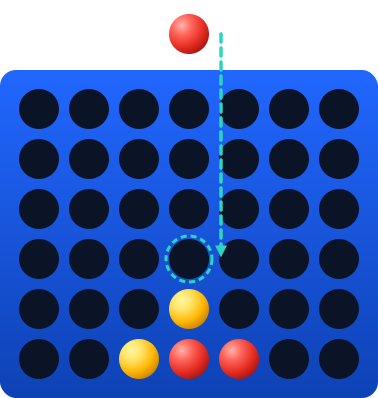
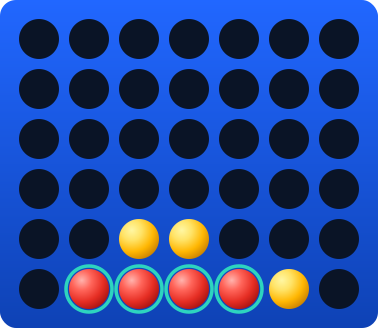
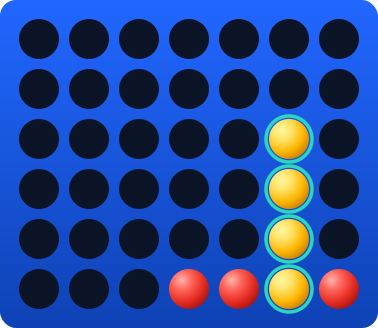
The goal is to be first to connect four of your own discs in an unbroken straight line. All three directions count: horizontal, vertical, and diagonal in either direction. The line must be exactly your discs with no gaps; three with a hole in the middle is a threat, not a win.
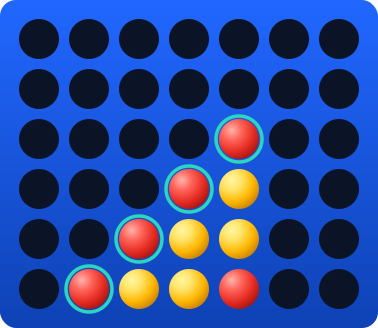
If all 42 cells fill with no winner, the game is a draw. That is the entire rulebook; on our board you just click a column (or the arrow above it) to drop, and the disc animates down. The depth of Connect 4 comes not from rule complexity but from how quickly innocent positions turn into traps.
Strategy: From Dropping Discs to Setting Traps
Own the center. The single most important idea in Connect 4. A four-in-a-row needs room, and the center column passes through more potential winning lines than any other: horizontal lines, both diagonals, and its own vertical. Edge columns touch far fewer. Open in the center, fight for it, and treat center cells as prime real estate throughout the game. This is not just folk wisdom; the computer analysis of the game (more on that in the FAQ) confirms the center opening is literally the strongest move possible.
Count threats, yours and theirs. A threat is a cell that would complete a four-in-a-row. Before every single move, scan for two things in this order: do I have a winning cell available right now, and does my opponent? Missing an opponent's open three is the way most Connect 4 games are lost, and the discipline of checking every turn is what separates casual droppers from players. One subtle trap: when you block, look at the cell ABOVE where your disc lands. Filling a column raises the floor, and the disc you drop to block one threat can hand your opponent the landing cell for another.
Win with double threats. Block one threat and the game continues; face two threats at once and the game is over. Creating a position with two winning cells that cannot both be blocked is the fundamental winning pattern of Connect 4, the equivalent of a chess fork. The classic picture: three discs in a row on the bottom with both ends open.
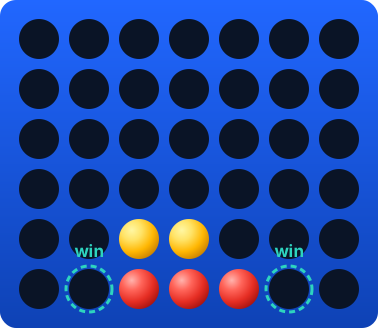
Building toward double threats quietly is the real craft. Strong players place discs that serve two future lines at once (a cell that sits on both a diagonal and a horizontal is worth more than one that serves a single line), and they avoid the open-ended three until it can no longer be prevented.
Think in levels, not just columns. Advanced Connect 4 is about WHICH ROW a threat sits on. Because discs fill from the bottom, a threat high in a column only triggers when the cells below it fill up, and you can often steer who is forced to fill them. The rough rule of thumb: as Red (first player), threats on odd rows (counting the bottom row as 1) tend to win the long game; as Yellow, even-row threats are gold. You do not need the full theory to benefit; just start noticing that a patient threat hanging above the action often decides the endgame, because eventually someone runs out of safe columns and must fill the cell beneath it.
Use the words players use. A lone cell completing a line is a threat; an unanswerable pair is a double threat or fork; the patient high threat is an odd threat or even threat depending on its row; and forcing your opponent to fill the cell under your threat is called zugzwang, a word Connect 4 happily borrowed from chess for "every move makes it worse."
Train against the AI like a ladder. Levels 1 and 2 miss threats the way beginners do, which is exactly what you need while the scanning habit forms. Level 3 blocks reliably and punishes obvious mistakes. Levels 4 and 5 look many moves ahead, never miss your open threes, and will build double threats out of positions that looked harmless three moves earlier. Losing to a level 5 trap and then replaying to see where it was actually set is one of the fastest lessons in the game. For focused practice, our puzzles page serves Connect 4 positions where the winning sequence is there to be found.
Frequently Asked Questions
Who goes first?
Red always moves first in our game, then turns alternate. First move is a genuine advantage here, bigger than in most classic games: the first player gets to claim the center and stays a tempo ahead in every threat race. When you play a series against a friend, swap colors between games; it keeps the match honest.
Is Connect 4 a solved game?
Yes, and it was solved twice independently in 1988. The verdict: with perfect play from both sides, the first player always wins, and only by starting in the center column. Open in one of the columns beside the center and perfect play ends in a draw; open anywhere else and the second player can force a win. Before that discourages you, remember what "perfect play" means: a complete, mistake-free reading of up to 42 moves. No human plays that way. At every human level, Connect 4 is decided by who spots threats and builds traps better, which is why it has stayed worth playing for decades after being solved.
What is the best first move?
The center column. It cuts through more potential winning lines than any other column, it denies your opponent the most valuable cell on the board, and the solved-game analysis crowns it formally: the center is the only first move that wins with perfect play. There is no second-best worth debating; just take the middle.
Can the game end in a draw?
Yes. Fill all 42 cells with no four-in-a-row anywhere and the game is drawn. It is rarer than in chess because the board offers so many line possibilities, but two careful defensive players can absolutely grind one out. If your games keep drawing, it usually means both of you block well but neither builds double threats; the strategy section above is the cure.
What happens when a column is full?
It closes. Six discs fill a column, and from then on it cannot be played by either side. This matters more than it seems: late in close games, the list of playable columns shrinks, and the player who manages it better forces the other to make a losing drop. If you have a threat waiting and your opponent is running out of safe columns, patience does the winning for you.
How do I start a game against the AI?
Everything happens in the quick setup panel on the Connect 4 page. The numbers below match the numbers on the screenshot:
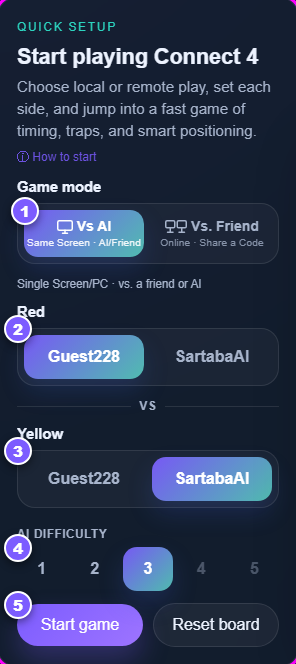
- Make sure the game mode is set to Vs AI (same screen). It is the default, so usually there is nothing to do here.
- Choose who plays Red: yourself or SartabaAI. Remember Red drops first.
- Choose who plays Yellow the same way. One side belongs to the AI; if you hand it the other side instead, the first side automatically becomes yours.
- Pick the AI difficulty, from 1 (relaxed) to 5 (trap-builder).
- Press Start game and drop your first disc.
Two details worth knowing: you can change the difficulty between games as you improve, and if you set both sides to human players, the same screen becomes a board for two, with a friend beside you taking the other color.
How can I invite a friend to play?
Playing against a friend takes one player creating the game and one player joining it. The numbers below match the numbers on the screenshot:
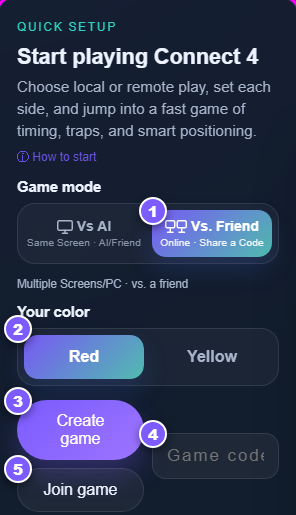
- Switch the game mode to Vs. Friend (online, share a code). Both players do this.
- As the creator, pick your color. Your friend automatically gets the other one.
- Press Create game. A 6-digit game code appears. Send it to your friend however you like.
- Your friend types that code into the game code box.
- Your friend presses Join game, and the match starts the moment the connection is made.
The creator sets all the game options, so the joining player does not need to touch the setup at all. The same flow works in every game on the site, not just Connect 4.
What difficulty should I start at?
Level 1 or 2 if you are new: they miss threats the way human beginners do, which gives you real chances to practice spotting and punishing. Level 3 plays a solid casual game and blocks reliably. Levels 4 and 5 read far ahead and specialize in exactly the double threats this guide teaches; treat losses to them as free lessons, and move up whenever you win more than half your games.
Can I play for free?
Yes. The game runs in your browser with nothing to install and no account needed for casual play. Three ways to play: a friend on the same screen, a friend anywhere in the world via game code, or SartabaAI at five levels. A free account is optional and adds saved statistics and a place on the leaderboard.
Where can I practice tactics?
Our puzzles page includes interactive Connect 4 positions: the board is set, a win exists, and your job is to find it against the AI. Puzzle solving isolates exactly the skill that wins games (seeing the threat before it lands) and a few minutes a day builds it faster than full matches. Puzzle results feed their own leaderboard points too.
Still have a question?
Send it through our contact page. Real questions from players are where half of this FAQ came from, and we read everything.