Chess Questions, Answered Properly
The questions below come up over and over, from new players, returning players, and people mid-argument about whether a move was legal. Tap any question to open its full answer. For the complete rulebook, see our chess rules guide.
Last updated:
Rules Questions
Can a pawn capture straight ahead?
No, and this is probably the most common rules misunderstanding in all of chess. A pawn moves straight forward but captures only one square diagonally forward. The strange consequence: a pawn staring directly at an enemy piece can neither take it nor walk through it. The two simply stand there, frozen, until something changes elsewhere. This is also why pawn chains lock against each other and shape the whole character of a position.
Can you castle out of check?
No. Castling while in check is illegal, full stop. The king also cannot pass through an attacked square or land on one along the way. You must answer the check some other way first, and here is the part that stings: if you answer it by moving the king, castling is gone for the rest of the game, even after the king returns to his starting square. The rook is under no such restrictions; only the king's path matters.
What is the difference between checkmate and stalemate?
Checkmate: the king is attacked and there is no legal escape. The attacker wins. Stalemate: the player to move has no legal move anywhere, but the king is NOT attacked. That is a draw, instantly, no matter how lopsided the material is. A player with a lone king can draw against a king, queen, and three pawns this way. If you are winning big, the burden is on you to leave the enemy king breathing room while you close the net.
Can you have two queens?
Yes. When a pawn promotes, you choose any piece except a king, and the choice is not limited by what is still on the board. A second queen is legal, a third is legal, and in theory a player could field nine. In practice, one extra queen usually ends the game quickly. The only caution worth knowing: with a huge material lead, a careless extra queen is the classic way to deliver an accidental stalemate.
What is en passant and when can I use it?
When an enemy pawn jumps two squares from its starting position and lands directly beside one of your pawns, you may capture it as though it had moved only one square. Your pawn slides diagonally onto the square the enemy pawn skipped, and the enemy pawn comes off the board. The window is exactly one move wide: play anything else and the right disappears for that pawn pair forever. It is a real, official rule, written into the laws of chess centuries ago, and our board supports it fully. The rules page has a step by step diagram if you want to see it.
Does the king ever get captured?
Never. Chess ends one move before the capture would happen. Any move that leaves your own king attacked is illegal, so you can never actually present your king for capture. Checkmate is the moment capture becomes unavoidable, and the game stops there. This is also why you cannot simply ignore a check: the rules will not let you make any move that fails to address it.
Why did my game end in a draw when I had more pieces?
Three likely culprits. Stalemate: your opponent had no legal move while not in check, often after their cornered king ran out of squares. Threefold repetition: the same position occurred three times with the same player to move, which is how perpetual check forces a draw. Or the 50-move rule: fifty consecutive moves passed without any pawn move or capture. Extra material protects you from none of these. If draws keep stealing your wins, the fix is endgame technique: keep making progress, keep pawns moving when safe, and always check the enemy king has a move.
Getting Better
What is a gambit?
A gambit is a deliberate sacrifice, almost always a pawn, offered in the opening to gain something less visible in return: faster development, open lines for an attack, or control of the center. The player offering the gambit is betting that the activity is worth more than the pawn. The most famous example is the Queen's Gambit, where White offers a side pawn to pull Black's central pawn off balance. The King's Gambit, wilder and older, offers a pawn right in front of the king for a fast attack.
Your opponent has two choices, and both have names. Accepting the gambit means taking the offered pawn and preparing to weather the storm. Declining it means ignoring the bait and developing normally. Neither choice is wrong; it is a matter of style. One warning for new players: a gambit is a real investment, not a trick. If you offer one and then play slowly, you end up a pawn down with nothing to show for it.
What is the best first move?
Chess has no solved best move, which is part of its charm. The two central pawn pushes, e4 and d4, have been the main battleground of master chess for two centuries because they grab central space and free pieces to develop. Knight to f3 is equally respectable. Honestly, for an improving player the choice between them barely matters; what matters is what you do next. Develop quickly, castle early, and fight for the center, and any of those first moves serves you well. Our strategy guide covers the full opening recipe.
How do chess piece values work?
The standard scale: pawn 1, knight 3, bishop 3, rook 5, queen 9. The king has no value because the game ends before he can be lost. Use the scale to sanity-check trades: a knight for a rook is a good deal (worth 3 for worth 5), while giving a rook for a bishop loses value. But treat it as a guide, not a law. A knight planted deep in enemy territory can outperform a rook stuck behind its own pawns. Activity bends the numbers, and learning when it bends them is a big part of improving.
Where can I practice chess tactics?
Our puzzles page serves interactive chess positions, including a puzzle of the day: the board is set, a win or a decisive advantage exists, and your job is to find it. Puzzle solving isolates exactly the skill that decides most games (spotting the fork, pin, or mate before it lands) and a few minutes a day builds it faster than full games do. Solved puzzles earn their own leaderboard points, and the strategy guide explains each of the tactical patterns the puzzles are built from.
What difficulty should I start at against the AI?
Start at level 1 or 2 if you are new or returning after a long break. The lower levels of our AI calculate less deeply, so they lose the way humans lose: missed forks, loose pieces, the occasional one-move blunder. That gives you realistic mistakes to punish, which is exactly how you build tactical vision. Move up when you win more than half your games comfortably. Levels 4 and 5 search several moves deep and will make you pay for wishful thinking.
Playing Here
Can I play chess online here for free?
Yes. The game runs in your browser with nothing to install and no account needed for casual play. Three ways to play: against a friend on the same screen, against a friend anywhere in the world by sharing a short game code, or against the AI at five levels. A free account is optional and adds saved statistics, puzzle progress, and a spot on the leaderboard.
How do I start a game against the AI?
Everything happens in the quick setup panel on the chess page. The numbers below match the numbers on the screenshot:
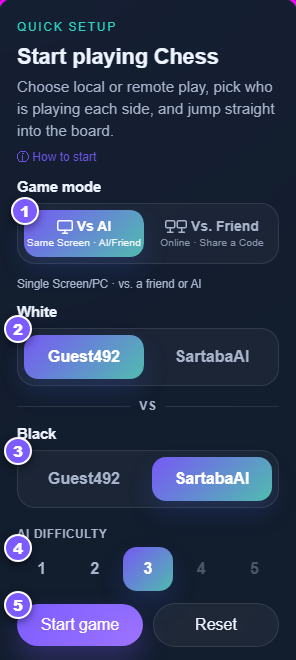
- Make sure the game mode is set to Vs AI (same screen). It is the default, so usually there is nothing to do here.
- Choose who plays White: yourself or SartabaAI.
- Choose who plays Black the same way. One side belongs to the AI; if you hand it the other side instead, the first side automatically becomes yours.
- Pick the AI difficulty, from 1 (relaxed) to 5 (ruthless).
- Press Start game and the board is live.
Two details worth knowing: you can change the difficulty between games as you improve, and if you set both sides to human players, the same screen becomes a board for two: a friend sitting next to you takes one side and you take the other.
How can I invite a friend to play?
Playing against a friend takes one player creating the game and one player joining it. The numbers below match the numbers on the screenshot:
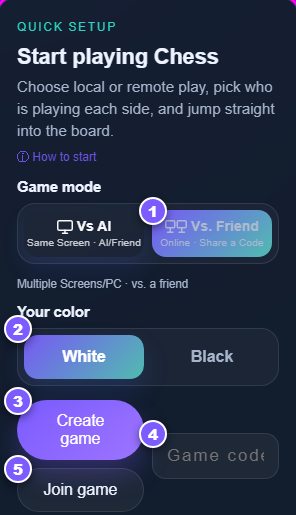
- Switch the game mode to Vs. Friend (online, share a code). Both players do this.
- As the creator, pick your color. Your friend automatically gets the other one.
- Press Create game. A 6-digit game code appears. Send it to your friend however you like: message, email, shouted across the office.
- Your friend types that code into the game code box.
- Your friend presses Join game, and the match starts the moment the connection is made.
One nice detail: the creator sets all the game options, so the joining player does not need to touch the setup at all. The same flow works in every game on the site, not just chess.
How long does a game take?
Casual online games typically run 10 to 30 minutes. Lower-level AI games tend to finish faster because decisive mistakes come earlier. There is no clock in our casual games, so a thoughtful game can take as long as it needs. If you only have five minutes, a quick game against level 1 or 2 fits nicely; an evening game against level 4 or 5 is a different kind of session entirely.
Still have a question?
Send it through our contact page. Real questions from players are where half of this FAQ came from, and we read everything.