
Chess Rules. The Complete Guide
Every rule of chess in one page, from setting up the board to the three special moves that surprise even experienced players. The diagrams below use the same pieces you will see on our board, so what you learn here looks exactly like what you will play.
Last updated
The Board and Starting Setup
Chess is played on an 8 by 8 board of 64 alternating light and dark squares. Each player commands 16 pieces. Eight pawns, two rooks, two knights, two bishops, one queen, and one king. White always moves first, then the players alternate, one move per turn. Skipping a turn is not allowed.
Two setup details trip people up. First, the board must be oriented so each player has a light square in their bottom right corner. Second, the queen starts on her own color. The white queen on a light square, the black queen on a dark square. If the kings and queens face each other across the board, you have set it up correctly. On our site the board is always set up for you, but it is worth knowing for the real thing.







How the Pieces Move
Six piece types, six movement patterns. A piece captures by moving onto a square occupied by an enemy piece, which is then removed from the board. You can never capture or land on your own pieces, and only the knight may jump over anything.
Pawn
Moves one square straight forward, or two squares on its very first move. Here is the twist that surprises every beginner. The pawn captures differently from how it moves. It can only capture one square diagonally forward, and it can never capture straight ahead. A pawn blocked by an enemy piece directly in front of it is simply stuck.
Rook
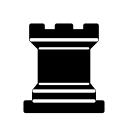
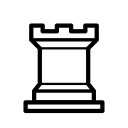
Moves any number of squares horizontally or vertically. Rooks are powerful on open files and ranks, and they grow stronger as the board empties out. Each player starts with two, tucked into the corners.
Knight
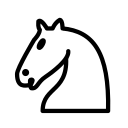
Moves in an L shape. Two squares in one direction, then one square at a right angle. The knight is the only piece that jumps over others, friend or enemy, which makes it dangerous in crowded positions where nothing else can move freely.
Bishop
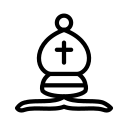
Moves any number of squares diagonally. Each bishop is locked to the color of square it starts on for the whole game, which is why players talk about a light-squared bishop and a dark-squared bishop. Together they cover the whole board. Alone, only half of it.
Queen
Moves any number of squares in any straight line, horizontal, vertical, or diagonal. She combines the rook and bishop in a single piece, making her by far the strongest piece on the board. Losing her without compensation usually loses the game.
King
Moves one square in any direction. The king is not a fighting piece for most of the game, but he is the whole game. If your king is trapped with no escape, you lose. The king may never move onto a square attacked by an enemy piece. One important consequence if it is your turn, your king is NOT in check, but you have no legal move anywhere, that is a stalemate and the game is an immediate draw. See check, checkmate, and stalemate below.
Castling
Castling is the only move where two of your pieces move at once, and the only time the king travels two squares. The king slides two squares toward a rook, and that rook hops over to land directly beside him. You can castle short (toward the closer rook) or long (toward the farther one).
The conditions matter, and they are strict. Neither the king nor that rook may have moved earlier in the game, not even once. This is the condition beginners miss most often. Even if the piece later returns to its starting square, the right to castle with it is gone forever. Beyond that, the squares between them must be empty, and the king cannot castle while in check, cannot pass through a square attacked by an enemy piece, and cannot land on one. One common mix-up. It is fine if the rook is attacked or passes through an attacked square. The attack restrictions apply to the king only.
En Passant
The most misunderstood rule in chess, and honestly one of the most elegant. When a pawn uses its two-square first move to land directly beside an enemy pawn, that enemy pawn may capture it as if it had only moved one square. The capturing pawn moves diagonally to the square the double-stepper skipped over, and the double-stepper is removed.
The catch. This capture is only available on the very next move. Wait one turn and the right is gone forever. The rule exists for a good reason. When the two-square pawn move was added centuries ago to speed up the game, players realized it let pawns sneak past enemy pawns without ever being capturable. En passant closed that loophole.
Pawn Promotion
When a pawn reaches the far end of the board, it must immediately become another piece. A queen, rook, bishop, or knight of its own color. It cannot stay a pawn and it cannot become a king. Nearly everyone chooses a queen, but promoting to a knight occasionally wins games a queen cannot, usually by delivering an immediate fork or checkmate.
Promotion is not limited by the pieces already on the board. You can have two queens, or in theory nine. On our board, a popup appears when your pawn reaches the last rank so you can pick your new piece.
Check, Checkmate, and Stalemate
When a king is attacked, it is in check, and the rules demand you deal with it immediately. You have exactly three options.
- Move the king to a safe square that no enemy piece attacks.
- Capture the attacking piece, with the king or with any other piece.
- Block the attack by placing one of your pieces in its path. This works against bishops, rooks, and queens, but never against a knight, whose attack jumps over anything in the way.
Any move that leaves your own king in check is illegal, including moves by other pieces that would expose him.
Checkmate is check with no way out. No escape square, no capture, no block. The game ends on the spot, and the player delivering mate wins. The king is never actually captured in chess. Trapping him is enough.
Stalemate is the situation people confuse with checkmate, and the difference is everything. If a player has no legal move at all but their king is NOT in check, the game is an immediate draw. Many a winning player has carelessly stalemated a cornered enemy king and thrown away the full point. When you are far ahead, always give the enemy king somewhere to move.
How Games End in a Draw
Beyond stalemate, chess has several other paths to a draw, and our game enforces all the standard ones.
- Threefold repetition the same position, with the same player to move and the same legal options, occurs three times. Perpetual check is the classic example.
- The 50-move rule fifty consecutive moves by each side pass without any pawn move or any capture. This prevents endless shuffling in dead positions.
- Insufficient material neither side has enough pieces left to ever deliver checkmate, such as king against king, or king and bishop against king.
- Agreement in over-the-board chess, players can simply agree to a draw at any point.
Your Sartaba Elo Rating
Every signed in player has a Sartaba Elo rating for chess. It is a number that goes up when you beat players who are as strong as you or stronger, and goes down when you lose to players who are as weak as you or weaker. It is our own scale and it is not an official FIDE rating, so a number here will not match a number from a club or another website.
- Where you start every new player starts at 1200. Your first 30 rated games move the number faster, and it shows a question mark until you have played them. After that the changes are smaller.
- What counts games against the computer and games against a friend online, when you are signed in. Games on one screen, games as a guest and tournament games do not count. One rating covers all games, with or without a clock.
- How much it moves beating a stronger opponent gives more than beating a weaker one, and losing to a weaker opponent costs more than losing to a stronger one. Between players of equal strength a win gives about 20 points at first and 10 later, and a loss costs the same. A win always gives at least one point.
- The computer has a rating too each of the five AI levels has its own Elo, and it moves a little with every game played against it. That way beating level 1 over and over soon gives you almost nothing. You can see the five ratings on the Chess Elo leaderboard and when you point at a level button before a game.
- Leaving a game if you close the page or start a new game after 6 or more moves against the computer, the game counts as a loss.
- Friends the same two accounts can have at most 4 rated games against each other in one day. Both players see each other's rating next to the name during the game.
- Where to see it your rating shows next to your name during a game, on the result card, in the Rating and badges tab of your profile, and on the Chess Elo leaderboard. By default your name shows on that leaderboard. A box in your profile hides it, and you then appear as Anonymous with a number.
Reviewing Your Game With the Computer
Every finished game can be reviewed move by move. Press Analyze Game on the result card, or on the button above Download Game next to the board, and a new tab opens with your game. The chess engine Stockfish looks at every position and tells you how good each move was. It runs on your own device inside your browser, it is free, you do not need an account, and nothing from the review is sent to our server.
- Move labels every move gets a label. Brilliant is a sacrifice that works. Great is the only move that keeps the position healthy. Best is the first choice of the engine. Excellent and Good are close to the best. Inaccuracy, Mistake and Blunder lose more and more of your winning chances. Miss means your opponent slipped and you did not use it.
- Accuracy each side gets a score from 0 to 100 for how close its moves were to the best ones. A higher number means fewer and smaller errors.
- The board shows the position after each move, a bar with who is ahead, and an arrow for the better move when you made an error. Use the arrow keys or the buttons to step through the game.
- Next issue jumps straight to your next mistake, so you can see the moments that decided the game without clicking through every move.
- How long it takes about a minute for a game of 40 moves on a computer, longer on an older phone. You can start reading while it works.
- What it is not the labels compare your move with the engine's best move, so a move can be a mistake even when you were still winning. Use them to learn, not to judge.
The Plus Number Next to a Name
During a game you may see a small plus number near a player's name or the pieces they have taken. It is a quick count of who is ahead, and it only shows next to the player who is ahead. In chess it is the material count. A pawn is worth 1, a knight or bishop 3, a rook 5 and the queen 9, so a plus 3 means that player is up about a minor piece.
Material is only part of the story. A player who is behind in pieces can still win with a strong attack or a checkmate, and a small material edge can be worth little in a closed position. The other games use the same idea with their own count. Checkers counts pieces, a man as 1 and a king as 1.5. Walls counts the steps left on each pawn's shortest path. Backgammon counts the pip lead in the race.
Playing With a Clock
You can play with no clock at all, or give each player 3, 5 or 10 minutes for the whole game. The clock only counts down while it is your turn, and when you move, your clock stops and your opponent's starts. Nothing is added after a move, so every second you spend thinking early is a second you will not have in the endgame.
- Running out of time if your clock reaches zero, you lose the game, even if you are winning on the board.
- The one exception if your opponent could never deliver checkmate with the pieces they have left, such as a lone king, the game is a draw instead.
- A short pause your clock waits half a second after each move before it starts, so you have a moment to see what changed. That half second is a delay, it is never added to your time.
- The server keeps the time the clocks run on our game server, so a slow connection or a closed tab cannot stop your clock or give you extra time.
- The computer plays by the clock too against the AI, it spends less time on each move as its own clock runs down, and in the last seconds it plays quickly. It is always charged at least half a second per move.
Try the Rules on a Real Board
Rules stick when you use them. Open our chess board, set the AI to level 1 or 2, and play a few casual games. The board highlights every legal move when you pick up a piece, so the movement rules reinforce themselves while you play. Castling, en passant, and promotion all work exactly as described above.