Backgammon Questions, Answered Properly
The questions below come up constantly, from new players, returning players, and people who learned slightly different house rules decades ago. Tap any question to open its full answer. For the complete rulebook with diagrams, see our backgammon rules guide.
Last updated:
Rules Questions
Who goes first?
In our game, White rolls and moves first, and when you create an online game you choose which color you take. In traditional over-the-board backgammon, the opening is decided by each player rolling one die, with the higher roller moving first using both dice as shown. Either way, the first-move advantage in backgammon is genuinely small; unlike chess, the dice reshuffle the position before any plan can build on a single tempo.
What happens when I roll doubles?
You play the number four times instead of twice. Double 5s means four separate moves of 5, distributed among your checkers however you like, as long as each step is legal. Big doubles late in a race are the famous backgammon swing: double 6s moves 24 pips in one turn. If the position only allows some of the four moves, you play as many as you legally can.
Why can't I move any other checker while one is on the bar?
That is the bar rule, and it is absolute: a hit checker must re-enter the board before the rest of your army may do anything. Re-entry happens in your opponent's home board on the point matching your die. If both dice point at blocked points (two or more enemy checkers), your whole turn is forfeit, and against a strong home board you can stay stuck for several turns. This is exactly why building home board points before hitting is such a strong plan, and why getting hit late in the game hurts so much. The rules page has a diagram of bar entry.
Can I choose not to play a die?
No, and this surprises players who learned casual house rules. If both dice can legally be played, both must be played. If only one can be played, you must play it. And the subtle one: if you could play either die on its own but not both together, the rules force you to play the higher die. There is no passing in backgammon; the only time you sit out is when no legal move exists at all. Our board enforces all of this for you, so an illegal "skip" simply is not offered.
Why can't I land on a certain point?
The point is blocked: it holds two or more enemy checkers. You may land only on points that are empty, owned by you, or holding exactly one enemy checker, which gets hit. One detail that catches people: a combined move is two separate hops, one per die, and each hop must land legally. A checker cannot tunnel through a blocked point even if the final destination is open. The board's highlighting shows only truly legal destinations, so when a point refuses to light up, this rule is usually why.
What are a gammon and a backgammon?
Backgammon grades the size of a win. A normal win means the loser bore off at least one checker; it is worth 1 point. A gammon means the loser bore off nothing: 2 points. A backgammon is the heaviest defeat: the loser bore off nothing AND still has a checker on the bar or inside the winner's home board, worth 3 points. On our leaderboard, wins against SartabaAI are scaled by difficulty too: level 3 pays full value, levels 1 and 2 pay a third and two thirds, and levels 4 and 5 pay 4/3 and 5/3. A backgammon against level 5 is the biggest single prize in the game.
When can I start bearing off?
Only when every one of your fifteen checkers is inside your home board. From there, an exact roll bears off a checker from the matching point, and a roll higher than your highest occupied point may bear off from the farthest occupied point, so big numbers are never wasted at the end. Two cautions: you may always choose to move within your home board instead of bearing off, which is sometimes safer, and if you get hit during the bear-off, that checker must travel the whole board again before you can continue. Won games are lost this way more often than you would think.
Is there a doubling cube?
Not in our version. The doubling cube comes from money backgammon: a die marked 2 to 64 used to raise the stakes mid-game, with the option to concede instead of accepting. We play every game to its natural finish, and the win type alone (normal, gammon, backgammon) decides the leaderboard points. If you later play cube backgammon at a club, everything you learn here transfers; the cube adds a layer of betting judgment on top of identical checker play.
Getting Better
What is a pip count?
Your pip count is the total number of dice pips you still need to bring every checker home and bear it off. Both players start the game at 167. Comparing your count with your opponent's answers the most important question in backgammon: who is winning the race? Ahead, you generally want to break contact and run; behind, you want to keep contact and play for a shot. You do not need exact arithmetic every turn; a habit of rough comparison is most of the value. Our strategy guide builds the whole game plan around this number.
Is backgammon luck or skill?
Both, and the proportions depend on how long you measure. In a single game, luck is real: a perfect position can lose to a miracle roll, which is precisely what keeps the game thrilling after 5,000 years. Across a session, the dice even out and the better player pulls ahead, because skill in backgammon means consistently taking the bets the odds favor: counting shots, building structure, picking the right plan. A useful way to think about it: the dice deal the hands, but you play them. If backgammon were pure luck, the same names would not keep winning tournaments.
What difficulty should I start at?
Levels 1 and 2 if you are new or rusty. Our AI evaluates full dice sequences, and at the lower levels it deliberately weighs them shallowly, so it leaves careless blots and misses hits, exactly the mistakes you need to learn to punish. Level 3 plays a sound club-level game. Levels 4 and 5 will make you pay for stacked checkers, loose blots, and racing from behind. Move up when you win more than half your games, and remember the leaderboard pays more for beating higher levels.
Playing Here
Can I play backgammon online here for free?
Yes. The game runs in your browser with nothing to install and no account needed for casual play. Three ways to play: against a friend on the same screen, against a friend anywhere in the world by sharing a short game code, or against SartabaAI at five levels. A free account is optional and adds saved statistics and a spot on the backgammon leaderboard.
How do I start a game against the AI?
Everything happens in the quick setup panel on the backgammon page. The numbers below match the numbers on the screenshot:
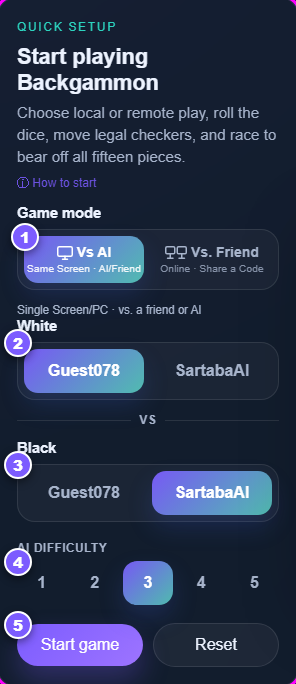
- Make sure the game mode is set to Vs AI (same screen). It is the default, so usually there is nothing to do here.
- Choose who plays White: yourself or SartabaAI. Remember White rolls first.
- Choose who plays Black the same way. One side belongs to the AI; if you hand it the other side instead, the first side automatically becomes yours.
- Pick the AI difficulty, from 1 (relaxed) to 5 (ruthless).
- Press Start game and roll.
Two details worth knowing: you can change the difficulty between games as you improve, and if you set both sides to Human, the same screen becomes a board for two, with a friend sitting next to you taking one side.
How can I invite a friend to play?
Playing against a friend takes one player creating the game and one player joining it. The numbers below match the numbers on the screenshot:
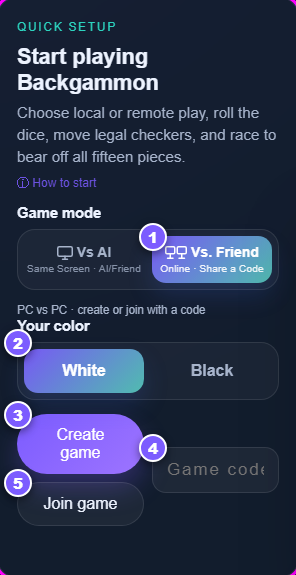
- Switch the game mode to Vs. Friend (online, share a code). Both players do this.
- As the creator, pick your color. Your friend automatically gets the other one.
- Press Create game. A 6-digit game code appears. Send it to your friend however you like.
- Your friend types that code into the game code box.
- Your friend presses Join game, and the match starts the moment the connection is made.
The creator sets all the game options, so the joining player does not need to touch the setup at all. The same flow works in every game on the site, not just backgammon.
Can I review the moves of a game?
Yes, and we recommend making a habit of it. The move history panel lists every move of the current game, and clicking any entry shows the board exactly as it stood before that move. When a loss feels like pure bad dice, replay it; in our experience there is usually one identifiable roll where the plan went wrong, and finding it is worth ten ordinary games of practice.
Still have a question?
Send it through our contact page. Real questions from players are where half of this FAQ came from, and we read everything.