
Walls Questions, Answered Properly
The questions below come up constantly, from new players and from people who know similar block-and-race games and want to know how our version works. Tap any question to open its full answer. For the complete rulebook with diagrams, see our Walls rules guide.
Last updated:
Rules Questions
Who goes first?
Player 1, the light pawn that starts on the top row, moves first, and turns alternate from there. When you create an online game you choose which side you take, and against the AI you decide which side it plays. The first-move advantage in Walls is genuinely small: a single tempo rarely decides a game on its own, because the loser of that tempo can usually answer with a wall.
Can a wall completely block my opponent?
No, and this is the rule that defines the whole game. A wall may never completely cut either player off from their goal. After every placement, both pawns must still have at least one open route, however long and winding, to the row they are racing toward. A wall that would seal a player in is illegal, and our board simply refuses to place it. Walls can lengthen a route but never close it, which is why you win by being faster, not by trapping. The rules page has a diagram of this.
How many walls do I get?
Ten each, and no more are ever handed out. Because the supply is fixed and every wall is permanent, your walls are scarce currency. Spend one that does not lengthen your opponent's path and you have simply handed them a free turn in the race. Running out early, with the finish line still far off, is one of the quickest ways to lose.
What happens when the two pawns meet?
You jump. When your opponent's pawn is directly next to yours, you do not waste a move stepping around it. If the square directly beyond them is open, you leap straight over and land on it, covering two squares at once. If a wall or the edge of the board blocks that straight jump, you may instead land on either square to the side of the opponent. This sideways jump is the only time a pawn ever lands on a diagonal, and it exists so a face-off can always be resolved.
Can I move and place a wall on the same turn?
No. Each turn is exactly one action: move your pawn one square, or place one wall, never both, and you can never pass. That stark either-or is what gives Walls its tension, because every wall you place is a step you did not take toward your own goal.
Can a wall be moved or removed once placed?
No. A wall stays exactly where you put it for the rest of the game. There is no taking it back, which is precisely why placement deserves a moment's thought: a wall dropped in the wrong groove is gone for good, and a careless one can end up blocking your own route as much as your opponent's.
Do walls block me too?
Yes. A wall blocks movement across its edge for both players, including the one who placed it. This catches new players out: a wall that adds a long detour for your opponent but also stretches your own path can be a losing trade. Always check what a wall does to your route before you commit it.
Getting Better
When should I place a wall instead of moving?
Count the race, then decide. Trace the shortest open path for each pawn and see who needs fewer steps to reach their goal. If you are ahead, keep moving and save your walls; you do not need them. If you are behind, spend walls to lengthen your opponent's route until the count comes back to even. The best walls sit directly across the opponent's shortest path and force the longest possible detour. Our strategy guide builds the whole game plan around this count.
What is the most common beginner mistake?
Wasting walls. The classic errors are placing a wall the opponent just steps around, which spends a turn for nothing, and emptying your whole supply early so you have nothing left when the race is close at the finish. The fix is one habit: before placing a wall, ask whether it costs your opponent more than the tempo it costs you. If not, move instead.
What difficulty should I start at?
Levels 1 and 2 if you are new. They spend walls loosely and misjudge the race, exactly the mistakes you need to practice punishing while your own wall sense forms. Level 3 plays a solid, considered game. Levels 4 and 5 look further ahead and will make you pay for every wall that does not earn its keep and every step in the wrong direction; these top two levels require a free account to play. Move up when you win more than half your games, and remember the leaderboard pays more for beating the higher levels.
Playing Here
Can I play Walls online here for free?
Yes. The game runs in your browser with nothing to install and no account needed for casual play. Three ways to play: against a friend on the same screen, against a friend anywhere in the world by sharing a short game code, or against SartabaAI at five levels. A free account is optional and adds saved statistics and a spot on the Walls leaderboard.
How do I start a game against the AI?
Everything happens in the quick setup panel on the Walls page. The numbers below match the numbers on the screenshot:
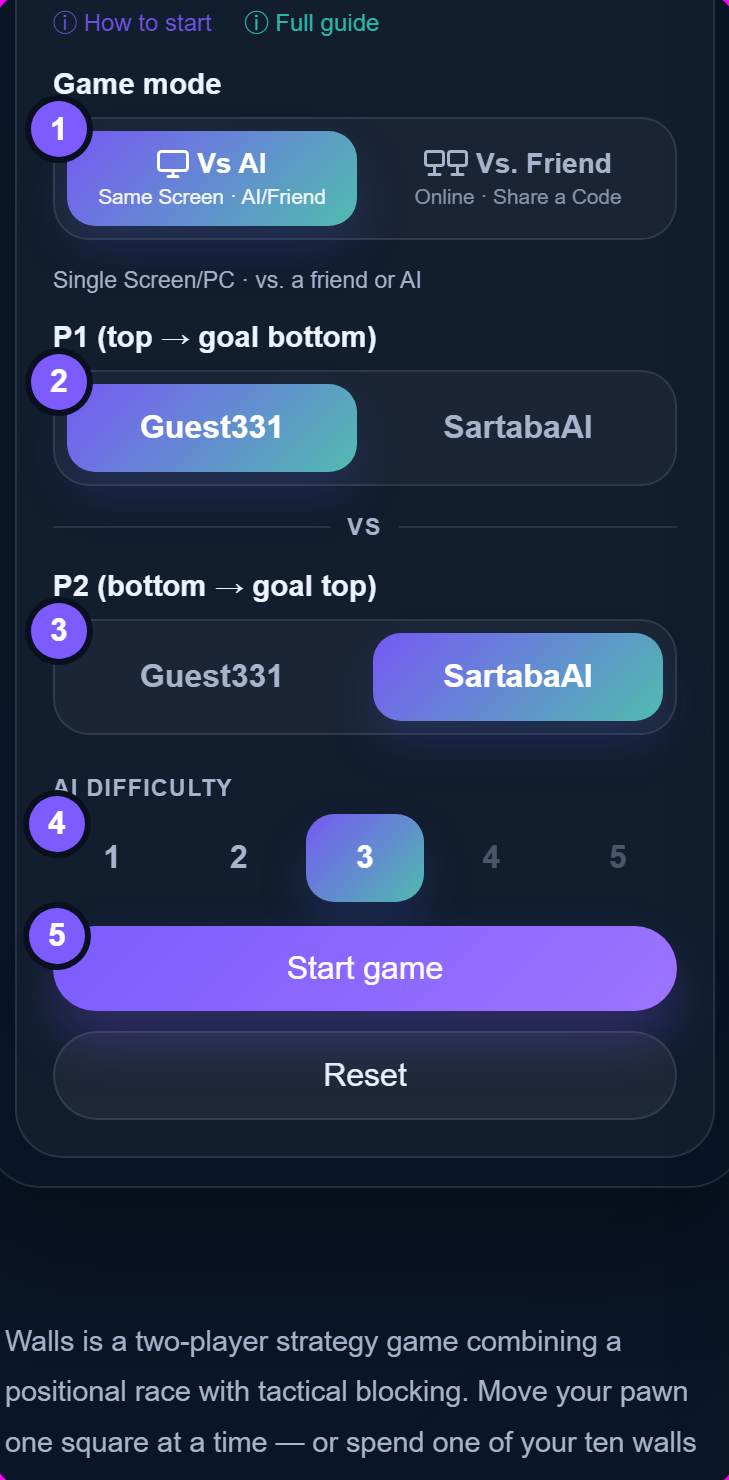
- Make sure the game mode is set to Vs AI (same screen). It is the default, so usually there is nothing to do here.
- Choose who plays P1 (top, races down): yourself or SartabaAI. Remember P1 moves first.
- Choose who plays P2 (bottom, races up) the same way. One side belongs to the AI; if you hand it the other side instead, the first side automatically becomes yours.
- Pick the AI difficulty, from 1 (relaxed) to 5 (ruthless).
- Press Start game and make your first move.
Two details worth knowing: you can change the difficulty between games as you improve, and if you set both sides to Human, the same screen becomes a board for two, with a friend beside you taking the other pawn.
How can I invite a friend to play?
Playing against a friend takes one player creating the game and one player joining it. The numbers below match the numbers on the screenshot:
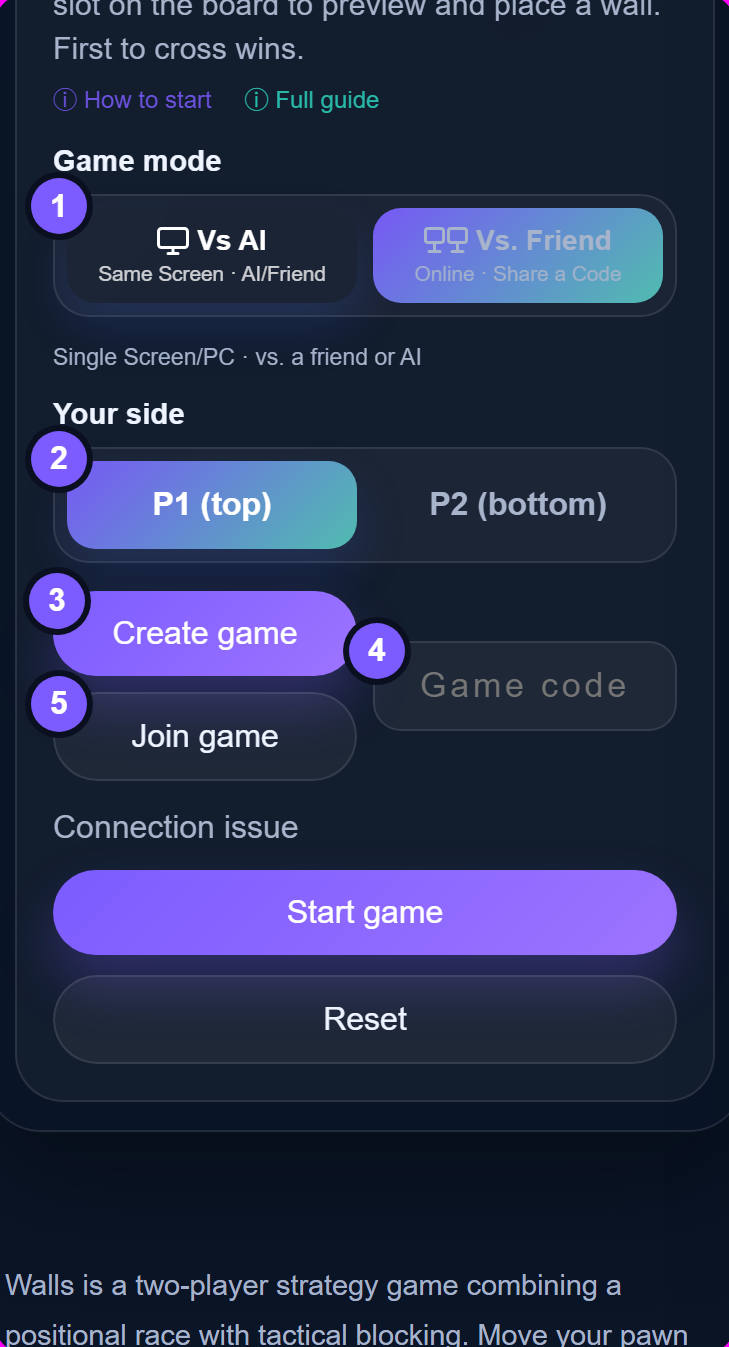
- Switch the game mode to Vs. Friend (online, share a code). Both players do this.
- As the creator, pick your side: P1 (top) or P2 (bottom). Your friend automatically gets the other one.
- Press Create game. A 6-digit game code appears. Send it to your friend however you like.
- Your friend types that code into the game code box.
- Your friend presses Join game, and the match starts the moment the connection is made.
The creator sets all the game options, so the joining player does not need to touch the setup at all. The same flow works in every game on the site, not just Walls.
Can I review or save a game?
Yes. The move history panel beside the board lists every move and wall of the current game as it happens. When a game ends, you can also use the Download Game option to save a video replay of it, which is a good way to study a loss: replay it and find the wall that did not pay for itself, or the turn you raced when you should have blocked.
Still have a question?
Send it through our contact page. Real questions from players are where half of this FAQ came from, and we read everything.