
Walls Strategy: Race, Block, and the Wall Economy
The rules of Walls take two minutes to learn. Playing it well is about one tension you feel on every single turn: should I advance my own pawn, or spend a wall to slow yours? This page teaches how to answer that question.
Last updated:
The One Idea Everything Hangs On
Walls is a race in which you are allowed to lengthen your opponent's track. That is the whole game in a sentence. Both pawns need a certain number of steps to reach the far side, and on every turn you either spend a step closing your own distance, or spend a wall adding distance to theirs. You cannot wall them in completely, because a path must always stay open, so a wall never wins outright. It only buys time.
So before any move, ask the one question that matters: who is closer to their goal right now, counting the actual walked distance, not the straight line? When you are ahead in that count, you want to race. When you are behind, you want to wall. Almost every beginner mistake in Walls is a misread of that count: racing when behind, or throwing walls when already ahead.
When we taught our AI to play, this balance was the core of it: weighing the value of one more step toward its own goal against the value of one more step added to the opponent's. The levels differ in how deeply they look ahead, which is why level 1 wastes walls cheerfully and level 5 makes every one of them hurt.
Walls Phrases and Terms: Speak the Language First
Walls borrows its vocabulary from the wider block-and-race family of games. These quick definitions make the rest of the page read easily. They are summaries, not full lessons; the mechanics are explained step by step, with diagrams, in our rules guide.
Board and Rules Terms
- Pawn: your single playing piece. Getting it to the far row is the entire object of the game.
- Goal row: the row on the opposite side of the board from where your pawn started. Reach any square on it and you win.
- Wall: a barrier two squares long, placed in the groove between squares, that blocks movement across that edge for both players. You start with ten.
- Horizontal / vertical wall: a horizontal wall blocks vertical movement; a vertical wall blocks horizontal movement.
- The path rule: no wall may completely cut either player off from their goal. At least one open route must always remain, which is why walls can slow but never trap.
- Jump: when the two pawns are adjacent, you leap over the opponent rather than stepping around. Straight if the square beyond is open, sideways if a wall or edge blocks it.
Strategy Terms
- The race / the count: the number of steps each pawn actually needs to reach its goal along the shortest open path. The single most important number in the game.
- Tempo: a single turn's worth of progress. Spending a wall costs you a tempo in the race, so the wall must cost your opponent at least as much.
- Detour: the extra distance a wall forces onto a pawn's route. A good wall adds a long detour; a wasted wall adds none.
- Wall economy: the discipline of treating your ten walls as scarce currency, spending each only when it buys more than it costs.
- Blocking: using walls to lengthen the opponent's route. Racing: using moves to shorten your own.
- Reserve: the walls you deliberately keep in hand for the endgame, when one well-placed wall can decide a close race.
Hear a term we missed? Send it through the contact page and we will add it.
Count the Race
Everything starts with the count. Look at your pawn and trace the shortest open path to your goal row, counting squares. Do the same for your opponent. The difference between those two numbers, adjusted for whose turn it is, tells you who is winning and by how much. You do not need perfect arithmetic every turn; what you need is the habit of asking the question.
The count chooses your plan. Clearly ahead, you race: move every turn, avoid spending walls, and let your lead carry you home. Clearly behind, racing is hopeless, so you must wall: spend walls to stretch the opponent's route until the count swings back to even. When the count is close, the game is at its sharpest, and a single wall or a single tempo can decide it.
Walls Are Currency: Spend Them Well
Ten walls sounds like a lot until you have spent six of them and the game is only half over. Every wall is permanent and irreplaceable, so the test for placing one is simple: does this wall cost my opponent more than the tempo it costs me? A wall that adds four steps to their route while costing you one turn is a brilliant trade. A wall that adds nothing, because they simply step around it, is a turn you handed away for free.
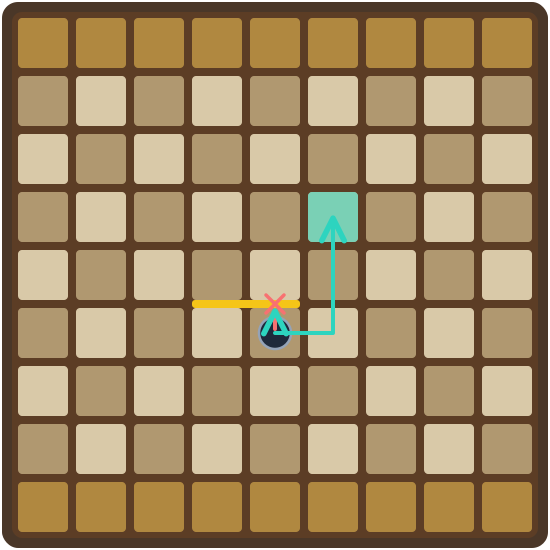
The strongest walls are placed directly across the opponent's shortest path, close enough that they must commit to the long way around before they can recover. Walls thrown down far from their route, or behind them where they have already passed, are pure waste. And never forget that a wall blocks you too: a barrier that lengthens your opponent's path while also lengthening your own is a poor bargain, sometimes a losing one.
Hold the Center, Keep Your Options
Where your pawn sits changes how many choices you have. A pawn in the middle of the board has four directions to move and can answer a new wall by slipping around it on either side. A pawn pinned against the edge has only three moves and far fewer ways to react, which makes it much easier for the opponent to herd with walls.
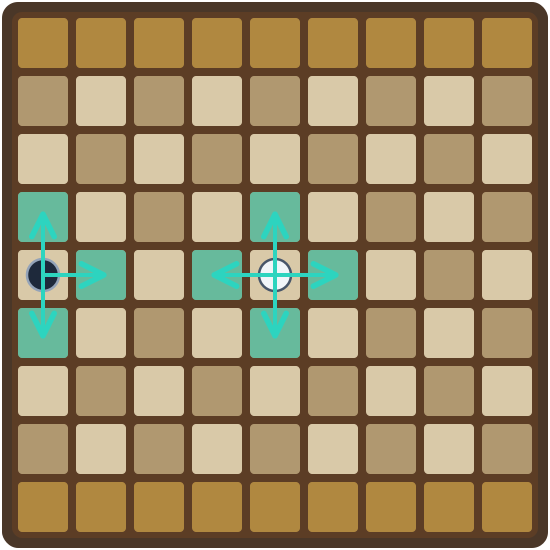
This does not mean marching straight up the middle every game. It means that when two routes are equal in length, the more central one is usually better, because it leaves your opponent guessing which side you will take and costs them more walls to cover both.
Block or Race: Reading the Position
Most Walls games settle into one of a few shapes, and recognizing which one you are in is the real skill.
- The clean race: both players are advancing and nobody is spending walls. If you are ahead in the count, this is exactly what you want. Keep moving and do not be tempted into walling a game you are already winning.
- The block: you are behind, so you spend walls to lengthen the opponent's path and drag the count back to even. Aim for the longest detour per wall, and stop the moment the count is level rather than emptying your supply.
- The standoff: both players hold walls in reserve and inch forward, each waiting for the other to commit. Patience wins these. The player forced to spend first often loses the wall economy.
The shape is never fixed. A race becomes a block the instant your opponent drops a wall in front of you, and a block becomes a race the moment the count evens out. Re-read the position after every wall.
Block Yourself to Lock In Your Path
This is the cleverest idea in Walls, and it comes straight out of the path rule. A wall can never seal a player off completely, and that cuts both ways. Suppose you have two ways to your goal: a short route and a longer way around. Your opponent would love to wall the short route and force you the long way. You can stop them before they ever try. Spend a wall to close off your own long route first, and the short route becomes your only path. Now your opponent cannot legally block it, because doing so would leave you with no route at all, which the rules forbid.
So a wall placed against yourself, sealing a detour you were never going to take, can be the strongest defensive move on the board. You give up a road you did not want, and in exchange your short path becomes untouchable. The rule of thumb is worth remembering: block the long way before your opponent blocks the short one.
Plan Ahead, Always
Every idea on this page rewards looking ahead, and in Walls looking ahead is unusually reliable, because walls are permanent and pawns move only one square at a time. Nothing on the board changes by surprise, so the player who reads further into the position almost always wins. Before you place a wall, trace your opponent's best reply, and the reply after that, and ask where the race will stand two and three moves from now, not just this turn.
The self-block above only works if you see your opponent's plan before they play it, and the wall economy only works if you already know which walls you will still want at the finish. Walls is a slow, deliberate game by nature. Treat every wall as a decision you cannot undo, because it is, and think a few moves further than your opponent is thinking.
The Endgame: Keep a Wall in Reserve
Late in the game, once both pawns are committed to their final approaches, Walls becomes pure counting. The player who reaches the goal in fewer remaining steps wins, full stop. This is why a wall held in reserve is so powerful: if the race is within a step or two, one wall dropped across your opponent's last stretch can be the entire difference, and they will have nothing left to answer it.
The matching warning is to never get so stingy that you lose the race while holding walls you were saving for a moment that never came. Reserve is insurance, not a trophy. If you are behind and the finish is approaching, spend.
Training With Our AI
The five levels are tuned for this journey. Levels 1 and 2 spend walls loosely and miss the count, which is exactly what you want while wall sense is forming: you get to practice punishing wasted walls. Level 3 plays a solid, considered game. Levels 4 and 5 look further ahead and will make you pay for every wall that does not earn its tempo, and for every step taken in the wrong direction; the top two levels require a free account to play.
One habit is worth building deliberately: after a loss, replay the game in your head and find the wall that did not pay for itself, or the turn you raced when you should have blocked. There is almost always one. Finding it is worth ten ordinary games of practice, and the leaderboard rewards courage too, paying more for wins against the higher levels.